United States

Trips to Florida

Sun, space centres, swamps and seven miles of open bridge

From the airboat trails of the Everglades to the neon-lit sands of South Beach, travelling to Florida means a different state every hour on the road.

The road tells you where to turn next
Florida

The road tells you where to turn next

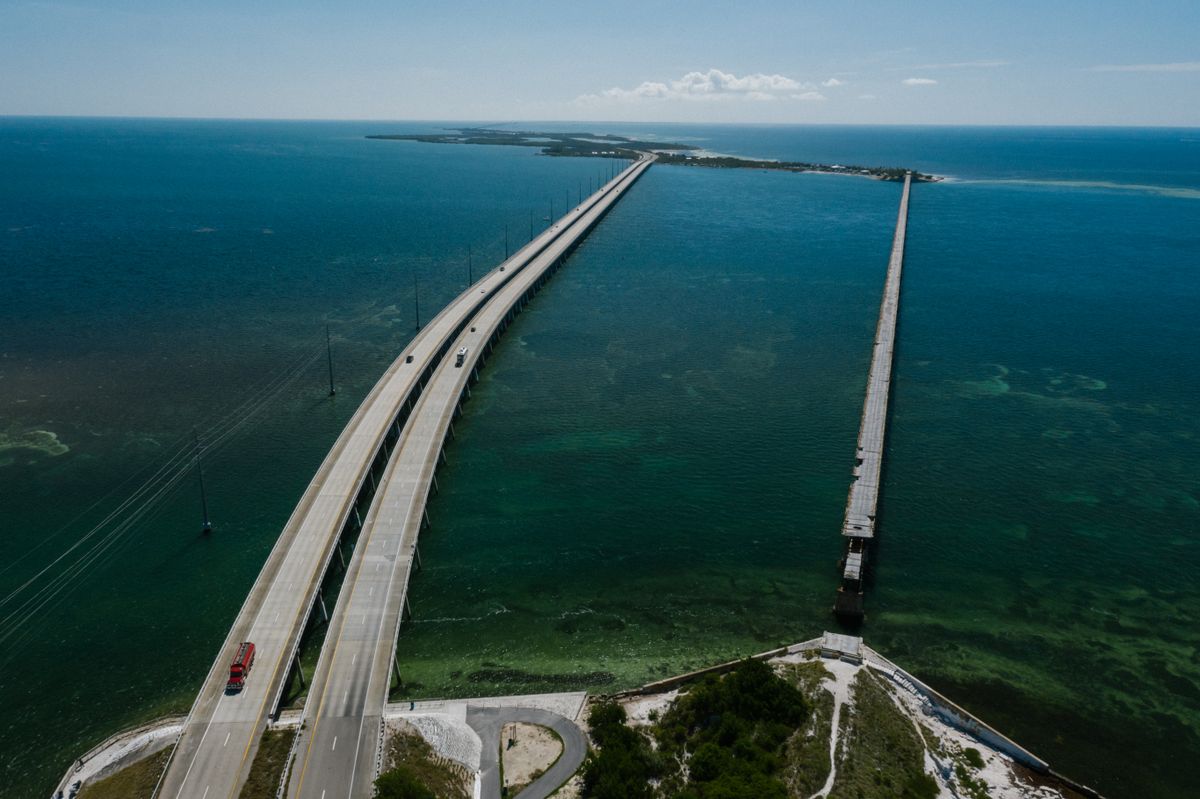
Drive the Overseas Highway south from the mainland and 42 bridges stitch 113 miles of coral islands together until the road simply runs out at Key West. There is nothing between you and Cuba but open water — and a slice of key lime pie waiting at the end.

A swamp that moves like a river

A swamp that moves like a river

The Everglades is not a marsh: it is a slow-moving river of grass, over 1.5 million acres wide, where alligators and crocodiles share the same water. Take an airboat at dawn, before the crowds, and the silence is as striking as the wildlife.

Four hundred years before Disney

Four hundred years before Disney

St. Augustine was founded in 1565 — 42 years before Jamestown. Walk the cobblestone streets around the Castillo de San Marcos at dusk, when the tour groups have gone, and the oldest city in the continental US feels genuinely old.

Travel More, Worry Less — that's how we do Florida

Florida rewards the traveller who lets someone else handle the logistics. Here's how Pro Buy Travel makes that happen.

  1. 01

    Groups that actually work

    Florida is a natural fit for group travel: shared transfers, block-booked parks, coordinated beach days. We handle the moving parts so the group stays together and on time.

  2. 02

    Cruises from the Sunshine State

    Port Canaveral, Miami and Tampa are three of the busiest cruise homeports in the world. We combine your Florida stay with a Caribbean or Bahamas sailing from the port that suits your route.

  3. 03

    One point of contact, start to finish

    From your ESTA to your hire car, one team handles the whole trip. You ask one question, you get one answer — no chasing separate suppliers.

We plan your trip to Florida

We help you choose how, when and for how long.

Send enquiry
Guide

What to see and do in Florida

Florida stretches more than 400 miles from north to south, which means the Panhandle beaches, the theme parks of Central Florida, the Art Deco blocks of Miami and the reef-fringed Keys each feel like a different destination. Here's how the state divides up.

Orlando & Central Florida
01

Orlando & Central Florida

Orlando is the theme-park capital of the world by any measure: Walt Disney World alone covers roughly the area of San Francisco, with Magic Kingdom, EPCOT, Hollywood Studios and Animal Kingdom on one site. Universal Orlando's Wizarding World and the recently opened Epic Universe add another full day each. Families routinely underestimate how much time the parks take — allow at least two full days per resort.

An hour east, Kennedy Space Center at Cape Canaveral walks you through every era of US space exploration, from Mercury to the current commercial missions. It works well as a half-day break from the parks.

Miami & South Florida
02

Miami & South Florida

Miami Beach's Ocean Drive is all pastel Art Deco frontages and white sand — worth a morning walk before the heat builds. But Miami is more than South Beach: the design district, Wynwood's murals and Little Havana's Calle Ocho give the city real texture beyond the shoreline.

Forty-five minutes south-west, the Everglades National Park — a UNESCO World Heritage Site — is an easy half-day from downtown. Biscayne National Park, just south of the city, is 95% underwater: snorkelling and diving are the main draws.

The Florida Keys
03

The Florida Keys

The Keys are connected end to end by the Overseas Highway, a 113-mile drive across 42 bridges ending at Key West. The reef running alongside — the third-largest coral system in the world — makes this one of the best snorkelling and diving destinations on the US East Coast.

Key West itself is compact and walkable: Duval Street bars, sunset at Mallory Square, and the southernmost point marker 90 miles from Cuba. Most visitors drive down from Miami in a day, but one or two nights en route lets the islands slow you down properly.

Gulf Coast: Tampa, Clearwater & the Panhandle
04

Gulf Coast: Tampa, Clearwater & the Panhandle

Clearwater Beach, on the Gulf of Mexico, consistently ranks among the best beaches in the country: fine white sand, warm turquoise water and a full menu of water sports from kayaking to parasailing. Tampa, just across the bay, anchors the stay with its 2.6-mile Riverwalk, Ybor City's cigar-making heritage and a lively food scene.

Further north, the Panhandle — Destin, Panama City Beach, Pensacola — has the whitest sand in the state and a noticeably different pace from South Florida. The trade-off: it's a long drive from Orlando (roughly five to six hours), so it suits travellers who base themselves on the coast rather than island-hopping the state.

North Florida & St. Augustine
05

North Florida & St. Augustine

St. Augustine is the oldest continuously inhabited European-established settlement in the continental US, founded by the Spanish in 1565. The Castillo de San Marcos — the oldest masonry fort in the continental US, completed in 1695 — and the narrow cobblestone streets of the old town make it a genuine step back in time rather than a reconstructed one.

This corner of Florida suits travellers who want history and a slower pace. Jacksonville is the practical gateway, and the historic Flagler College and Lightner Museum add to a very walkable historic district.

When to travel to Florida

Florida's climate varies more by season than most visitors expect, and the right timing depends on where in the state you're going.

November to February
Dry season at its best: mild days of 18–24°C, minimal rain and the busiest travel period. South Florida and the Keys are at their most comfortable; North Florida can have cold snaps.
March to May
Spring brings warm temperatures (24–29°C), low humidity and manageable crowds — except during spring break weeks in March, when theme parks and beaches fill up fast.
June to August
Hot (above 30°C), humid and with daily afternoon thunderstorms. Beaches and water parks are popular with families during school holidays, but pack waterproofs for the afternoon.
September to October
The quietest and cheapest window, but also the peak of hurricane season (most active mid-August to late September). Best for budget-conscious travellers comfortable with weather risk.
Before you travel to Florida

Before you travel to Florida

Entry & ESTA
UK visitors: no visa, but ESTA required before departure (apply at esta.cbp.dhs.gov, at least 72 hours ahead). US citizens: valid ID only.
Language
English throughout. Spanish is widely spoken in South Florida and Miami's Little Havana.
Currency
US Dollar (USD). Cards accepted almost everywhere; keep some cash for smaller tips and markets.
Time zone
Eastern Time (ET). UK is 5 hours ahead in winter (EST) and 4 hours ahead in summer (EDT).
Electricity
Type A/B plugs, 120V. UK travellers need a plug adapter; check voltage compatibility for older appliances.
Health & insurance
No mandatory vaccinations. Travel insurance with medical cover is strongly recommended — US healthcare costs are high.
Getting there
Direct flights from the UK: 8h 45m–10h to Orlando (MCO/SFB), Miami (MIA) or Tampa (TPA).
Getting around
Hire car is by far the most practical option. Florida stretches 400+ miles north to south; intercity public transport is very limited.

Frequently asked questions about travelling to Florida

Do UK travellers need a visa or ESTA for Florida?
No visa — but you must obtain ESTA approval before you travel. Apply online at esta.cbp.dhs.gov at least 72 hours before departure. The ESTA is valid for two years and covers multiple stays of up to 90 days each. Check the official site for the current fee, as amounts vary by source.
How long is the flight from the UK to Florida?
Direct flights take between about 8 hours 45 minutes and 10 hours, depending on your UK departure airport and whether you fly into Orlando, Miami or Tampa. British Airways and Virgin Atlantic both operate scheduled routes from London Heathrow.
What's the best time of year to visit Florida?
November to April is the most reliable window: warm days, low rainfall and comfortable humidity. Spring (March–May) is particularly good if you want slightly lighter crowds — just avoid spring break weeks in March if you're not travelling with kids.
Should I worry about hurricane season?
Florida's hurricane season runs from 1 June to 30 November, with the most active period typically mid-August to late September. Travelling outside that window removes the risk entirely. If you go in September — the cheapest month — make sure your travel insurance covers weather disruption.
Do I need a hire car in Florida?
For most trips, yes. The state is large (400+ miles top to bottom), public transport between cities is limited, and most attractions sit outside walkable city centres. A car gives you the flexibility to combine, say, Orlando with the Gulf Coast or drive the Keys at your own pace.
How many days do I need for Walt Disney World?
Walt Disney World has four full theme parks. To cover them without rushing, allow a minimum of four full park days — more if you want to repeat favourites or visit Disney Springs and resort areas. Add Universal Orlando and you're looking at a week in Central Florida alone.
Can I combine theme parks with a beach holiday?
Easily. Orlando is roughly 90 minutes from Clearwater Beach on the Gulf Coast and about an hour from the Atlantic beaches around Cocoa Beach. A classic two-centre trip splits time between parks and coast — and works well for groups with mixed interests.
What's there to do in Florida beyond the theme parks?
Quite a lot: airboat tours of the Everglades, snorkelling on the Florida Keys reef, the historic streets of St. Augustine, Gulf Coast beaches, a Kennedy Space Center visit, and freshwater spring swimming with manatees in Crystal River. Florida's 1,350+ miles of beaches alone give you weeks of options.

Ready to plan your Florida trip?

Tell us who's travelling, when you're thinking of going and what matters most — beaches, parks, cities or all three.

Step 1 of 5
Where would you like to go?

Pick one or more, or type it.

Made withsiteway.travel